 looksmatch
How Looksmatch works
Your report shows your estimated photo rating, portraits that scored similarly and a fictional lookalike. You can explore the features the scanner picked up in your photo.
Who shows up as a rating match?
The collection contains 7,000 fictional adults aged 18-70. Each photo goes through the same scanner as yours. Among portraits that fit your preferences, the report shows the same rating first. If you give your age, people closest to your age come first within that rating. The default search then includes portraits up to half a point away. Choose exact ratings in Compare matches to keep that gap at zero.
How does it find my lookalike?
Find my lookalike searches the full fictional collection for a portrait with similar features. It compares details such as the spacing of the eyes and how the face narrows from the cheeks to the chin. A lookalike can have a different photo rating from yours.
When there’s a close feature to show, select Show me to trace it on both photos. You might see a resemblance around the eyes even when the rest of the face looks quite different. A front-facing photo makes the shapes easier to compare.
See why the demo portrait has two different matches.
Two photos of one face
Here are two pictures of the same fictional person in the collection, Portrait 387. The retake scored half a point higher.
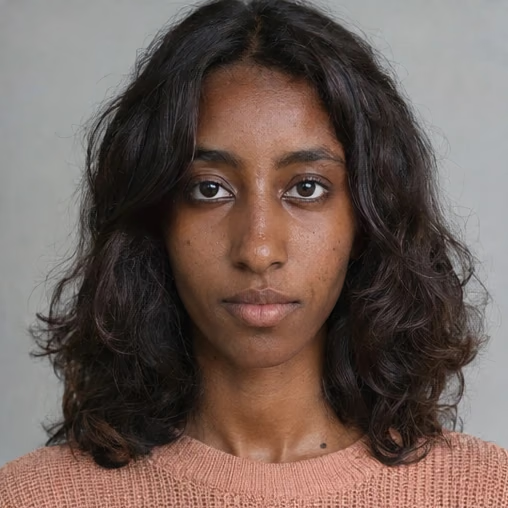
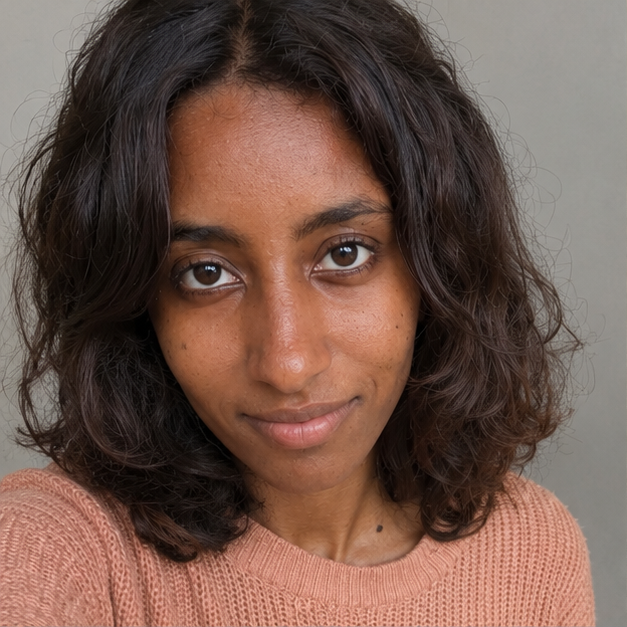
Expression, lighting and how close you hold the camera can all change what the scanner sees. Several things changed between these pictures, so the difference can’t be put down to any one of them. You can add up to two more photos to your scan for a combined estimate.
Reading mouth width
On the 1,440-pixel-wide copy used for this illustration, the mouth spans about 140 pixels and the cheeks span about 336. Divide 140 by 336 and you get about 42%. When you see 42% beside mouth width in the live example, it means the mouth spans just over two fifths of the width across the cheeks.
Making the whole image smaller shortens both lines together, so their proportion stays the same. A smile can move the mouth corners farther apart and give a different reading.
What the other numbers mean
Eye spacing measures the distance between the centres of the pupils as a share of that same cheek width. The live example shows about 46%, a little under half the width across the cheeks.
Face proportions compares the distance from the upper forehead point to the chin with the distance across the cheeks. In the live example, 1.20× means the first line is about 20% longer than the second.
The illustration uses saved points. The live face map finds them afresh, so a small shift in where a point lands can change the last digit of a reading.
Comparing two photos
Use the same camera, distance and expression for both. Keep the phone level with your eyes, look straight at the lens and leave both cheeks and your chin in frame. Even light makes it easier to see where the points landed.
Then try changing just one thing. Turn your head slightly in the second photo and compare the cheek endpoints. The far cheek can appear nearer the middle of the picture, which can change every reading that uses cheek width. If a point appears in the wrong place, try a clearer, more front-facing photo.